


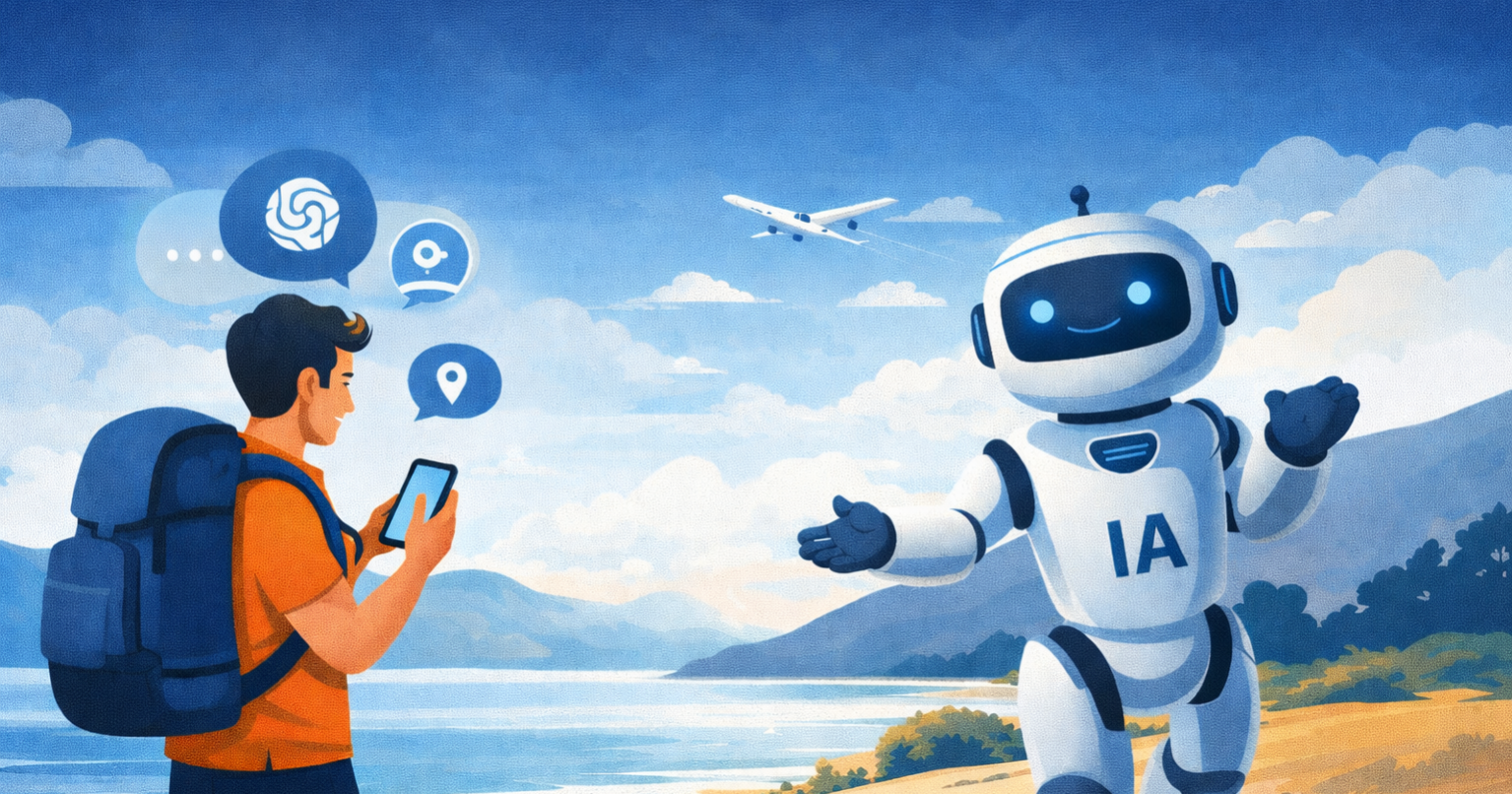
Artificial intelligence (AI) has become a key ally for travellers in the travel industry. According to the report “Remapping travel with Agentic AI” by McKinsey & Company in collaboration with Skift, 55% of consumers already use ChatGPT or other AI-based applications to plan their trips. Of these, 30% do so regularly and 25% do so occasionally.
This study highlights the opportunities offered by agentic AI, a technology capable of acting, reasoning and executing tasks autonomously. The report details the transformative capabilities of this technology and proposes a roadmap for its adoption by leaders in the travel industry.
Remarkable progress, but full potential yet to be realised
While AI has been rapidly adopted in the travel space, its full value has yet to be fully deployed. In 2022, only 4% of companies in the Skift Travel 200 index mentioned AI in their annual reports, rising to 35% in 2023. In parallel, AI-specialised startups in the sector have gone from attracting 10% of venture capital in 2023 to 45% in the first half of 2025.
Perceived benefits explain this boom. According to a survey of 86 industry executives, the use of AI helps reduce operating costs, improve decision-making, increase customisation, optimise product quality and significantly raise internal productivity.
Consumer confidence on the rise, but with limits
More than 90% of travellers trust the accuracy of information generated by AI tools. In addition, 60% would prefer to book with companies that integrate agentic AI-based travel assistants capable of handling the entire travel planning, booking and adjustment process.
However, the autonomy granted to these tools remains limited: only 2% of respondents would allow an AI to make or modify bookings without human supervision. Confidence also varies according to the task: 72% value their usefulness for search and inspiration, compared to 58% for procedures such as visas, and 53% for incident resolution.
Structural challenges and strategic vision
The tourism sector faces structural barriers that hinder the full implementation of AI. These include technological fragmentation, reliance on legacy systems and the prioritisation of the human component over innovation.
According to Javier Caballero, partner at McKinsey & Company:
“The adoption of AI is growing dramatically, but the travel industry still faces structural challenges that prevent it from capturing its real value. Fragmented data, manual processes and limited technology approaches hold back transformation. Agentic AI presents itself as a qualitative shift to overcome these barriers and move towards more integrated and efficient operating models.”.
Agentic AI and its transformative impact on travel
Unlike generative AI, which responds to requests, agentic AI acts proactively: it monitors the environment, identifies moments of intervention, designs a plan and executes it with minimal human supervision. This capability makes it a disruptive resource in tourism.
Thanks to its ability to operate interfaces like a real user, combine structured and unstructured data, and execute multi-step tasks, it can solve complex processes such as itinerary planning or last-minute logistical adjustments.
According to Caballero:
“The true potential of agentic AI lies not only in its ability to automate tasks, but in its ability to transform the way problems are solved in the industry. By enabling faster, more accurate and personalised interventions, this technology opens the door to more seamless travel experiences and far more efficient operations.”.
Progressive implementation in key areas
Consumers' familiarity with these tools accelerates their adoption: almost seven in ten are willing to use an assistant to manage an entire journey.
Industry executives share this vision: according to the report, 40% plan to implement agentic AI in areas of customer experience and service delivery, 37% in sales, and 34% in marketing. Technology is positioned as a strategic focus in areas linked to experience and demand generation.
Applications in the tourism back-office
Agentic AI also has great potential to reshape the internal operations of hotels, airlines and tour operators. Some applications highlighted by McKinsey & Company include:
- Automated room allocation based on preferences, history and loyalty.
- Predictive maintenance with sensor data and assessments.
- Dynamic optimisation of housekeeping according to actual occupancy.
- Automatic adjustment of prices and offers in catering according to demand and profitability.
Recommendations for effective integration
Despite its potential, many companies cite two key obstacles: a shortage of technical profiles and the lack of a clear roadmap. The report recommends:
- Define a common strategic vision between business and technology areas.
- Prioritise the use cases with the highest impact.
- Ensure that the first projects generate visible benefits that drive uptake.
In conclusion, companies that effectively integrate this technology must consider its impact on the entire value chain. Agentic AI is not just a tool, but a driver of end-to-end transformation that will enable the redesign of processes, reduce friction, scale personalisation and free up human talent for higher value-added tasks.
Source: www.campingprofesional.com
 Español
  English (UK)